Luodong Forestry Culture Park
「The log pond still remembers the growth rings of the cypress」
Free admission | Zhulin Station · log pond
Official info ↗ ↗
Mountain Story· The Long Read
Ten stories · about 12 minutes | The origins of the Taipingshan Mazu pilgrimage and the century-old forestry site

Each year, the gods of the lowlands come up the mountain as guests.
A mountain pact of more than half a century, renewed each year by casting the divination blocks.
Act I· Act I · Scene 1
The Atayal people called these mountains Mianao — the place of deep forest.
In 1915, the first hinoki cypress fell. The last of Taiwan's three great forestry districts to be opened, it became the most productive of all — at its peak, eighty thousand cubic metres of timber came down the mountain each year, surpassing Alishan.
80,000m³/yr
Peak annual output — the highest in Taiwan
Before felling, you first cut a 'directional notch' into the trunk to control exactly which way the great tree falls — in the mountains, skill is safety.
Act II· Act I · Scene 2
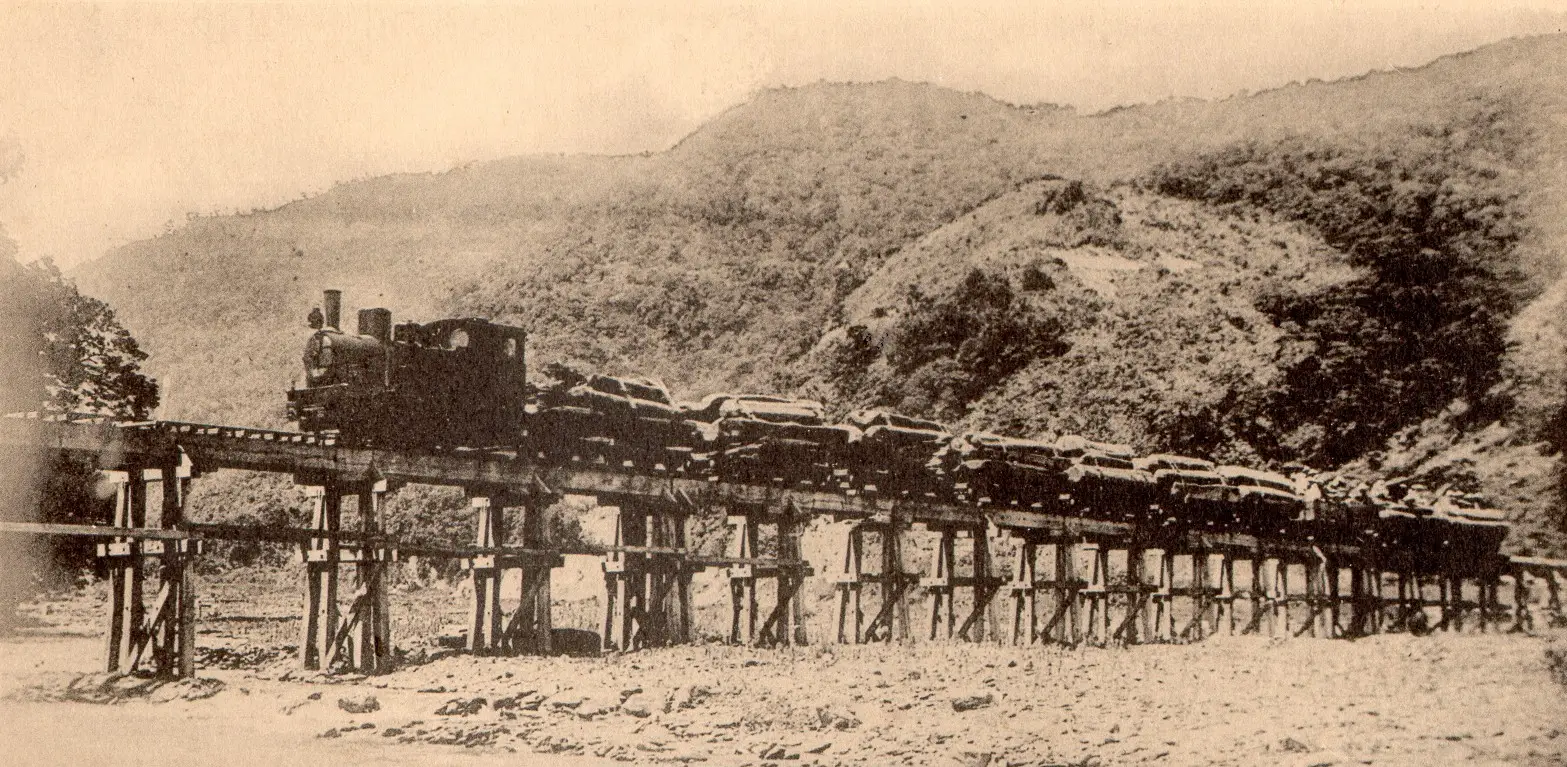
In 1924, the Luodong Forest Railway opened. Three cableways and four rail sections carried the whole mountain's hinoki cypress down, log by log.
In the days before there were roads, people rode the cableways across the valleys alongside the timber.
Praying for safety was never ritual — it was how you stayed alive.
「Every nightfall, the mothers would watch and wait, uneasy until their men came home safe.」
Act III· Act II · Scene 3
In 1936, the Jialuoshan Shrine was moved with the forestry district to the new Taipingshan and renamed the Taipingshan Shrine, enshrining the sun goddess Amaterasu.
After the war, the shrine site was rebuilt as a temple. Most of the loggers on the mountain came from Yunlin and Chiayi — homesick, they brought their hometown's Koxinga up with them; they also honored Koxinga's deep-rooted national spirit, hoping it would inspire the mountain's people to unite and work hard. In 2021, this little hinoki temple, the Taipingshan Zhen'an Temple, was listed as a historic building.
And each spring, it is the mountain's host who invites the gods of the lowlands up as guests.
In the forestry era, at the start of each Lunar New Year the manager would lead the whole staff to Zhen'an Temple to pay their respects — greeting the mountain's host before a year's work began.
Act IV· Turn
From Luodong at 10 meters, climbing all the way to the 1,950-meter clouds.
▲ After the Lantern Festival
The date changes from year to year: after the Lantern Festival, the temple asks Koxinga by casting the divination blocks — even the day is the god's own choosing.
▲ 10 m
Three convoys split onto three routes to gather the eleven deities of eight temples; the three parties reunite at a relay point and ascend together — this is the courtesy owed to the gods. Most of the mountain's loggers came from the coastal lowlands of Yilan, where every household honored Mazu; year after year the sea goddess climbs the mountain, and the ones she watches over are these same homesick people of the mountain.
The Luodong Zhen'an Temple was founded in 1837 (the 17th year of the Daoguang reign); by tradition a wandering monk carried its deity image from the ancestral temple on Meizhou, making it the oldest Mazu temple in Luodong. In 1867 (the sixth year of the Tongzhi reign) a typhoon wrecked the temple, and a military-examination graduate named Huang Yongzai raised funds to rebuild it with front, middle, and rear halls; the 'One in Merit with Heaven' plaque hanging in the main hall is said to have been bestowed by the Guangxu Emperor. After the great earthquake of 1922 left it in ruins, it was rebuilt and named Zhen'an — 'peace after the quake.' For Taipingshan, welcoming Mazu each year is like inviting her home to her mother's house.
The Luodong Sheng'an Temple, popularly called the 'Chiayi Temple,' was funded by timber merchants from Chiayi and Yunlin — and when it was built, its orientation was set to face straight toward Taipingshan.
The Caohu Yuzun Temple grew from a Jade Emperor devotional association founded in 1940. In 1945, a devotee named Chen Acai carried the Jade Emperor's image from place to place in search of a temple site, choosing the present one by casting the divination blocks — the blocks have always been the way people speak with the gods.
▲ 350 m
At Tuchang's Fude Temple, Prince Nezha, the Earth God and the Earth Goddess are already waiting at the gate — the locals receiving the visitors is the mountain's rule of propriety. Inside, mushroom chicken soup simmers; it is cold up here.
▲ 520 m
The white steam of the geothermal springs lights the first incense for the palanquins. The crew have boiled a pot of red eggs and wait by the roadside — red for luck and life, and peace all the way.
Jiuzhize's springs were already developed into a bathhouse in the Japanese colonial era, the water seeping down through cracks in the rock at the mountain's foot. This weakly alkaline sodium bicarbonate spring leaves the skin smooth and silky, like a natural lotion — earning it the nickname 'Beauty Spring'; tinted pale blue and milky white, it is praised as 'the sapphire of the hot springs,' and it is said that even the Japanese emperor once admired its fame. The spring was renamed 'Renze' after the war, only later reverting to Jiuzhize.
▲ 950 m
The road becomes a ribbon of light, and the procession slips into the clouds. The mountain's own Earth God has gone down ahead, waiting by the roadside to lead the way — on his own mountain, he guides them himself.
▲ 1,840 m
Taiwan's largest alpine lake, its full surface spanning some twenty-five hectares. When the wind stills, the lake gathers in the whole procession along with the light of the sky — the mountain holds up a mirror for the gods.
The Cuifeng Lake Loop Trail was certified by Quiet Parks International in 2022, becoming the world's first internationally certified Quiet Trail. The moss works like natural sound-proofing; at its quietest, the sound level falls below 25 decibels — a natural recording studio.
▲ 1,900 m
A hinoki-wood lodge at nearly nineteen hundred metres, the whole room fragrant with cypress. A simple plate of fried rice vermicelli and hot food warms every stomach in the bitter mountain cold, and warms the heart too — just like that pot of mushroom chicken soup at Tuchang the night before.
▲ 1,950 m
The palanquins board the train — a dozen-odd deities riding together, just once a year. Three kilometres of track: the closest to heaven any procession comes in all of Taiwan.
Its formal name is the 'mountain timber-transport railcar,' once used mainly to haul logs. The 'bong-bong' nickname comes, by one account, from the early wooden carriages jolting and swaying up and down the slopes with that sound; by another, it was the noise of the wheels crossing the rail joints. In 1991, the timber cars were converted to carry passengers, becoming today's Bonbon Train.
Maoxing Station was once known as 'Wandan Station,' named for a yield of three thousand cubic metres of timber per hectare — wood from here once built Japan's shrines and palaces. The tracks that once carried timber for those shrines now carry the gods.
▲ 1,950 m
Red purple-maple leaves line the way; one stair, one step; one step, one wish. Stepping off the Bonbon Train, there are still more than two hundred steps to go — at the four hundred ninety-sixth step, Zhen'an Temple waits at the top of the stairs.
Up the two hundred–odd steps to the Bonbon Train station, the crew hold the deity images against their chests, one step, one stair at a time. 'Even if it's hard, we feel it's worth it.'
▲ 1,950 m
At 1,950 metres, the highest temple in all of Yilan. It began as a Shinto shrine from the logging era; after the war, homesick loggers from Yunlin and Chiayi brought their hometown's Koxinga up the mountain, and this little hinoki temple has watched over the mountain's people ever since. In 2021 it was listed as a historic building. After two days of procession, the gods take up their lodging here — tonight, the mountain is full.
In the forestry era, at the start of each Lunar New Year the manager would lead the whole staff to Zhen'an Temple to pay their respects — greeting the mountain's host before a year's work began.
Act V· Union
「I left Taipingshan back in primary school — almost fifty years ago now. Coming back to my birthplace alongside the gods, my heart is full.」
「I was born here and went to school here. What I remember most is the air.」
「Holding the deity in my arms, there's a feeling of great safety, and I don't even feel tired. As long as I'm posted at the Taipingshan work station, I'll take part every year.」
Welcoming Mazu at Taipingshan: A Bonbon Train Trip with the Gods?!|Gau Duen TV — Taiwan's Hundred Temples|2024 event documentary|Watch on YouTube
Act VI· Act IV · Scene 6
The logging era is over, yet more than thirty forest keepers remain on the mountain. The Taipingshan work station watches over a full sixty-four thousand hectares, dense with red cypress, false cypress, incense cedar, and Taiwan yew — truly 'the homeland of the hinoki.' They patrol this forest, and against the 'mountain rats' (timber poachers) who come carrying blades they hold no weapons — only a radio to call it in.
Once a year, the gods come to the work station to give their blessing — once, the loggers prayed for safety; now the forest keepers pray for it too.
The direction of the guarding has reversed; the heart of it has not.
In its heyday, the Taipingshan settlement was home to some five hundred households — a repair shop, a police post, an infirmary, a barbershop; the mountain was a small town unto itself.
Transfiguration· Three Rebirths of the Rail Lines
The logging tracks never vanished — they became three new paths.
Jianqing Line
One of CNN's 28 most beautiful trails in the world
0.9 kilometres of old logging track, its mossy rails and switches still in place. In these often-misted mountains, people longed to 'see clear sky' (jianqing) through the white haze — and from that longing the trail takes its name.
Cuifeng Line
The world's first internationally certified Quiet Trail
Certified by Quiet Parks International in 2022. The moss works like natural sound-proofing; at its quietest, the sound level falls below 25 decibels — a natural recording studio.
Maoxing Line
Taiwan's highest deity procession
Once a year, a dozen-odd deities ride the same train. The tracks that once carried timber for Japan's shrines now carry the gods themselves.
View the 3D modelIn 2024, the Luodong forestry site turned one hundred. The first event of its centennial was the Welcoming of Mazu at Taipingshan.
Leave home happy, come home safe.
See the cycle of guardianship in 3DChronicle· Finale
Logging begins at Taipingshan (the last of the three great forestry districts to open, yet the most productive in Taiwan)
The Luodong Forest Railway opens (Tuchang–Zhulin; closed 1979)
The Jialuoshan Shrine is relocated with the forestry district and renamed the Taipingshan Shrine
After the war, Zhen'an Temple is rebuilt; loggers from Yunlin and Chiayi bring their hometown's Koxinga up the mountain
Forestry workers begin welcoming Mazu up the mountain, praying for safety
Logging ends amid a shift in forestry policy; the following year the site is reborn as a national forest recreation area
The Bonbon Train is converted to carry passengers
Zhen'an Temple is listed as a historic building
Typhoon Gaemi devastates the Maoxing Line — a severe slope collapse scours away the roadbed and suspends service
Torrential rain collapses kilometre 7 of Yizhuan Route 1 (the Taipingshan access road); after emergency reinforcement, the park stays open under single-lane two-way traffic control
The full Maoxing Line of the Bonbon Train reopens
The park closes for about two months to fill the sinkhole at kilometre 7; asking Koxinga with the divination blocks, the procession is postponed to May
The first May procession is completed (dates subject to the organizers' announcement)
In late April 2025, torrential rain collapsed the 7K mark of Yizhuan Route 1 — the lower slope dropped more than ten storeys and about fifteen metres of roadbed caved in. After the slope and roadbed were shored up, the park stayed open under single-lane two-way traffic control. In the spring of 2026, to fill that sinkhole, the park closed again for about two months (open only as far as Jiuzhize); the people put the question to the Taipingshan Zhen'an Temple's Koxinga by casting the divination blocks. An affirmative cast: move it to May. The full Maoxing Line had reopened the year before, and the thirty-five guided-tour spots sold out within five minutes of opening.
Images: various Wikimedia Commons photographers (see /images/CREDITS.md)|Video: Gau Duen TV — Taiwan's Hundred Temples (2024 event documentary)
Some oral accounts are drawn from the documentary Climbing Taipingshan with the Gods.
Routes and some coordinates are illustrative; event dates are subject to the organizers' announcement.
Three landmarks from the story, rebuilt as 3D models you can spin with your own hands.
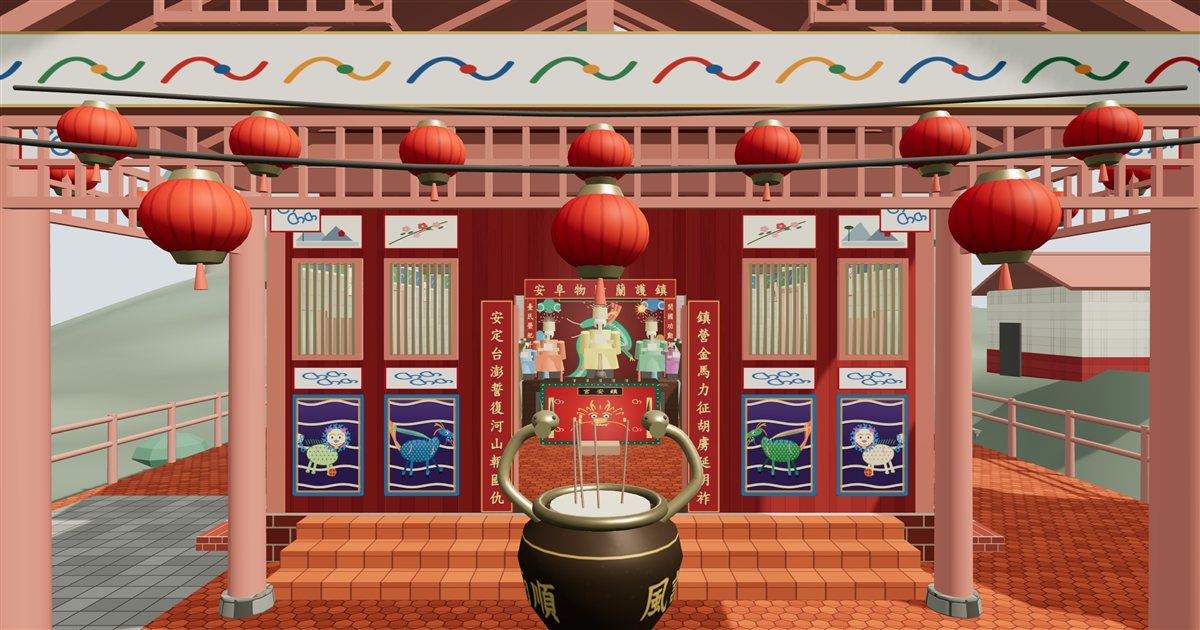
Zhen'an Temple at 1,950 metres — switch between day, night and drifting mist.
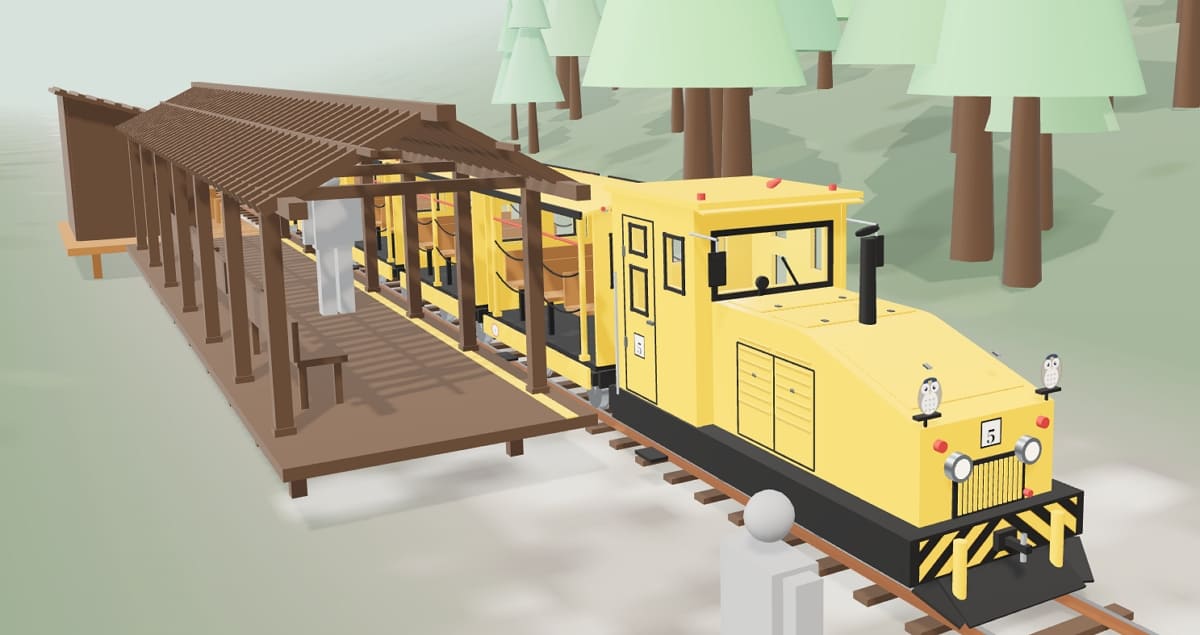
The Maoxing-line Bonbon Train — a locomotive and ten open carriages you can set in motion.

Steam locomotive No. 15 at Zhulin Station, wooden carriages coupled behind.
Visit· Visit the Incense Road
Opening hours, trail conditions, and ticketing are subject to the official announcements of the Yilan Branch of the Forestry and Nature Conservation Agency.
「The log pond still remembers the growth rings of the cypress」
Free admission | Zhulin Station · log pond
「The white steam that lights the palanquins' first incense」
'Beauty Spring' | hot-spring egg-boiling pool
「496 steps, lined with the red leaves of purple maples」
Purple maples are reddest from April to October
「Once a year, the gods ride this train too」
Taipingshan Station – Maoxing Station · about 3 km · about 20 minutes one way
「One of the world's most beautiful trails, once a logging track」
0.9 km · easy for all ages
「The world's first Quiet Trail — a forest of 25 decibels」
3.95 km · quiet section 2.2K–3.6K
「Just up the steps behind Taipingshan Lodge, under ten minutes into the ancient hinoki forest」
600 m loop · about 30 minutes · second-generation trees
Nature· Natural Ecology
The gods come up the mountain as guests once a year. These residents stay all year round — and some of them have stayed for tens of thousands of years.
The road the gods take uphill is also a road through three forest zones
0–1,000 m
Luodong → Tuchang
Formosan sweetgum, schefflera, large-leaved nanmu, makino bamboo
1,000–1,550 m
Tuchang → Zhongjian
Taiwan red cypress, Taiwan incense cedar, Taiwan red maple, wheel tree
1,550–2,100 m
Zhongjian → Zhen'an Temple
Taiwan hemlock, Taiwan false cypress, Taiwan rhododendron, millennium-old red cypress
Papilio maraho
Endangered · endemic to Taiwan
「First seen at Ubōshi, in 1932」
One of Taiwan's rarest butterflies, trailing broad tails from its hindwings. Its only wild host plant is the Taiwan sassafras — the butterfly can only live where that tree lives. May to August around Jiuzhize offers the best chance of meeting one; males descend to streams at about 400 metres to drink.
May–Aug · Jiuzhize | Elevation 1,000–2,000 m
Otus lettia glabripes
Endemic subspecies · protected
「On the spring night the gods went up, someone in the trees was watching」
Eight owl species have been recorded on Taipingshan, and the collared scops owl is one of them. The most frequently seen is the Himalayan owl — the indicator species for this mountain's nocturnal raptors. In the spring and summer breeding season they perch in the treetops along Yizhuan Route 1 and the Cuifeng Scenic Road, waiting for small animals crossing the road. That is the same road the palanquins take uphill, in the same season.
Spring–summer nights · treetops along Yizhuan Route 1 | 8 owl species on the mountain
Fagus hayatae
Ice-age relict · rare and precious plant
「Older than every story on this mountain」
A deciduous member of the beech family that grows over twenty metres tall, left behind by the Ice Age. The 1,154-hectare habitat around Tongshan is Taiwan's largest beech home; in autumn the whole stand turns gold. The first 2.5 kilometres of the trail leading there is laid on a former timber-hauling railway — mileposts, work huts and switches are all still in place.
Golden in autumn · Beech Trail 3.8 km | Elevation 1,600–1,800 m
Syrmaticus mikado
Endemic to Taiwan · protected
「The largest and most nobly plumaged of all Taiwan's endemic birds」
Taipingshan has recorded 164 bird species across 53 families. The mikado pheasant walks quietly along the forest roads at misty dawn and dusk; its relative the Swinhoe's pheasant is even more numerous here.
Dawn & dusk · forest roads | 164 species in 53 families
Zhangixalus moltrechti
Endemic to Taiwan
「It calls like a turkey, and the whole mountain hears it」
Taipingshan's amphibians number 13 species in 4 families. Moltrecht's green tree frog is found throughout the area; Japanese tree frogs swarm at Jiuzhize, and olive frogs call from the shore of Cuifeng Lake. After dark, this mountain is anything but quiet.
Night · throughout the area | 13 amphibian species in 4 families
Macaca cyclopis
Endemic to Taiwan · commonly seen protected species
「Of fourteen mammals, the one you are most likely to meet by the road」
Fourteen mammal species live on Taipingshan — Formosan black bear, yellow-throated marten, sambar deer and Reeves's muntjac are all on the list, and the macaque and the muntjac are the ones most often seen. The Formosan black bear, an endangered endemic subspecies, has only left old traces here.
Daytime · roadsides and forest edges | 14 mammal species
Ecological data: Forestry and Nature Conservation Agency — Taipingshan National Forest Recreation Area official site (Natural Ecology; Watching Himalayan Owls in Spring and Summer; Taiwan Beech Trail) and the Conservation website (Broad-tailed Swallowtail). Species photographs are CC-licensed works taken in Taiwan (not photographed on Taipingshan itself); each is credited with author and licence.
On real terrain, follow the golden incense trail climbing from Luodong to the 1,950-meter Zhen'an Temple.